
Why ‘No Refunds’ Signs in Kenyan Shops Are Not, Strictly Speaking, Legal — And Why Almost Nobody Challenges Them
You spot a blender at a busy electronics stall in Nairobi. The price is right, the packaging looks solid, and the salesperson assures you it is the very model his own mother uses. You pay cash, carry it home in its box, and on Saturday morning you attempt to make the smoothie that has been on your mind all week.
The blender will not start. You check the socket, the fuse, the plug. Nothing. You read the manual. You try again. Still nothing. The machine is dead.
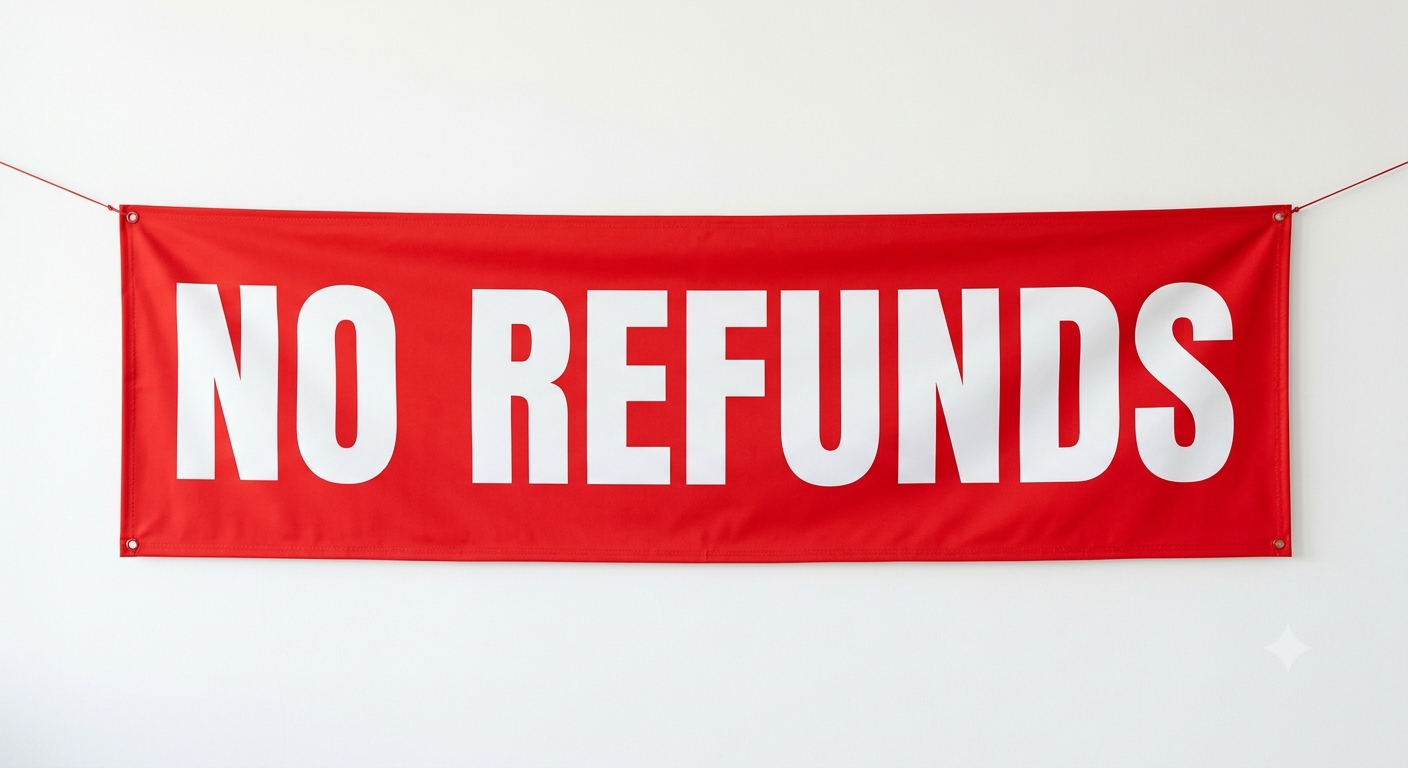
The following Monday, you return to the shop. You explain the situation calmly and politely. You produce your receipt. The shopkeeper listens, nods slowly, and then gestures at the wall behind the counter where, in bold red lettering on a laminated card, the following words appear:
“NO REFUNDS. ALL SALES ARE FINAL.”
The shopkeeper’s expression makes clear that the conversation is over. You walk out with a broken blender and a receipt that, apparently, entitles you to nothing.
Here is what that shopkeeper did not tell you: that sign, in those circumstances, is very likely not the end of the legal story.
The Sign on the Wall Is Not the Law
It is easy to understand why these signs feel final. They are large, they are authoritative, and they are stated with the confidence of someone who believes they are protected. In Kenya’s retail market, the “no refunds” sign has become so common that both shoppers and shop owners have come to treat it as a self-executing legal instrument. It is not.
A sign fixed to a wall by a seller is, at best, a statement of that seller’s preferred contractual policy. It is not legislation. It cannot override rights that Parliament has expressly granted to consumers. And that is precisely what the Consumer Protection Act, 2012 does — it grants certain rights that a seller cannot simply disclaim by way of a notice.
The critical question is not whether the sign exists. The critical question is whether what the sign is trying to do is something the law actually permits that seller to do in the circumstances of your particular transaction.
What Kenyan Consumer Law Actually Protects
The Consumer Protection Act, 2012 (the “CPA”) is the primary legislative instrument governing the relationship between traders and consumers in Kenya. It applies to agreements between a supplier and a consumer for the supply of goods and services, and it imposes a range of obligations on suppliers that cannot simply be contracted out of.
Under the CPA, a consumer has a right to goods that are of good quality and in good working order, that are safe, that are free from defects, and that are suitable for the purpose for which they are ordinarily used. These are not terms that exist only if the shop agrees to include them. They arise from the statute itself.
This distinction matters enormously. In ordinary contract law, two parties can largely agree to whatever terms they choose. But consumer protection legislation exists precisely because Parliament recognised that in the retail context, there is usually a significant imbalance of power and information between the seller and the buyer.
The CPA steps in to set a floor below which a seller cannot go, regardless of what any sign or contractual clause purports to say.
| Key Legal Point
The Consumer Protection Act, 2012 creates statutory rights that exist independently of any sign, notice, or contractual term in a shop. A seller cannot disclaim these rights simply by posting a notice. The law gives consumers a baseline of protection that must be observed regardless of shop policy. |
When a Seller Can Still Lawfully Refuse a Refund
Accuracy demands that we be honest here: not every customer who is refused a refund has a legal claim. The law does not give a consumer an automatic right to return goods simply because they have changed their mind, found a better price elsewhere, or decided they do not like the colour.
A “no refunds on change of mind” policy is, in many circumstances, a perfectly lawful expression of retail practice. If you buy a dress, get it home, and decide you prefer a different style, the shop is not legally obliged to take it back simply because you regret the purchase. If the goods are exactly as described, in perfect working order, and fit for their purpose, the seller’s refusal to accept a return may well be entirely within the law.
Similarly, where a consumer has been clearly informed of a specific exclusion before the purchase — for example, that personalised goods cannot be returned, or that sale items are sold as-is with known defects disclosed — that exclusion may form a legitimate part of the contract.
The law in Kenya does not impose a universal cooling-off period for retail purchases in the same manner as some other jurisdictions. Whether a particular refusal is lawful depends very much on the specific facts: the nature of the goods, how they were sold, what was represented, and what went wrong.
When the Sign Does Not Save the Seller
The position changes materially when goods are defective, misdescribed, or not fit for the purpose for which they were sold.
Defective Goods
Return to the broken blender. If a product fails because of a manufacturing defect — not because of misuse, accidental damage, or ordinary wear after extended use, but because something was wrong with the product itself — the seller cannot simply rely on a “no refunds” sign to escape liability. The CPA imposes obligations on suppliers with respect to product quality, and a seller who supplies a defective product cannot disclaim those obligations by posting a notice.
The remedies in such a case may include repair, replacement, or, in appropriate circumstances, a refund. Which remedy applies, and in what sequence, will depend on the particular facts. But the starting point is that the sign does not extinguish the consumer’s right to complain and to seek a remedy.
Misdescription
The law is also concerned with how goods are described and represented. If a trader represents that a product has certain features, qualities, or capabilities that it does not in fact have, that representation can give rise to legal liability under the CPA and, depending on the circumstances, under general contract law principles as well.
If the salesperson told you that the blender has a 2-year manufacturer’s warranty and it does not, or that it operates on 240 volts when it does not, those representations may have formed part of the basis on which you decided to buy. A sign on a wall cannot erase a misrepresentation that preceded the sale.
Unfair Contract Terms
Beyond the CPA, Kenya’s contract law recognises principles governing unconscionable and unfair contract terms, and there are provisions under the CPA that speak to misleading representations and unfair trade practices.
A blanket exclusion that attempts to remove all consumer rights in all circumstances — regardless of the nature of the problem — can, in appropriate cases, be challenged on these grounds. The extent to which such a challenge will succeed will turn on the facts of each case.
| Practical Illustration
A consumer buys a gas cooker. The retailer’s sign says: “No refunds. No exchanges.” Within 48 hours, the regulator valve fails due to a manufacturing fault, and a fire is narrowly avoided. The consumer returns to the shop. The seller points to the sign. In these circumstances, the sign does not protect the seller. The goods were not of merchantable quality. They were not safe. The seller has obligations under the Consumer Protection Act that arise independently of any notice. The consumer has a right to seek a remedy, which in a case involving a safety issue may go beyond a simple refund. |
Defective Goods Versus Change of Mind: The Critical Distinction
A great deal of confusion in this area arises from a failure to distinguish between two fundamentally different situations:
- The consumer wants to return goods because they are defective, damaged, misdescribed, or unsafe.
- The consumer wants to return goods because they have changed their mind.
These are not the same legal situation. The first engages statutory rights and seller obligations in a way that a sign cannot easily override. The second is primarily a matter of the parties’ contract, and if the seller has clearly communicated a no-return policy before the sale, that policy may well be enforceable.
What makes matters more complex is that sellers often deploy the sign equally in both situations, as though the distinction does not exist. A consumer returning a genuinely defective product is treated the same as a consumer returning a perfectly good product out of regret. This is not legally sustainable, even if it is commercially convenient.
Why Proof Matters: Evidence Is Everything
Suppose you have a legitimate complaint. The goods are defective. You want a remedy. The seller refuses. At this point, the strength of your position will depend very heavily on what you can actually demonstrate.
A consumer who has kept their receipt, photographed the defect, retained the original packaging, preserved WhatsApp messages in which the seller described the product, and acted promptly in bringing the complaint is in a fundamentally stronger position than one who has none of these things.
| Evidence to Gather Immediately
If you have a refund dispute, preserve the following as a matter of urgency:
|
In e-commerce transactions, the position is often somewhat clearer in the consumer’s favour, because the entire transaction history exists in writing. Product listings, order confirmations, delivery records, and complaint threads all form part of the evidential record. A well-documented online consumer complaint is often easier to pursue than one arising from a purely oral transaction at a market stall.
Repairs, Replacements, Exchanges, and Refunds: Not the Same Thing
Many consumers believe that their only option when goods fail is to demand cash back. In practice, the available remedies may take several forms, and the appropriate remedy will depend on the facts.
A seller who offers to repair a defective product is providing a remedy, and in some circumstances, this may be the first and most appropriate step. However, if a repair proves ineffective, or if the product presents a safety risk, or if repair is not feasible, the consumer’s entitlement may extend further. The CPA recognises that consumers are entitled to goods that meet a certain standard; where they do not, the question of what remedy is owed is one that turns on the nature and extent of the problem.
The distinction between an exchange (receiving a different unit of the same product) and a refund (receiving money back) is also commercially and legally significant.
A seller may prefer to offer an exchange as a first response to a complaint about defective goods. Whether the consumer is entitled to insist on a refund rather than an exchange will depend on the circumstances, but the consumer is generally not obliged to accept a third or fourth repair attempt indefinitely when the product has a fundamental or recurring defect.
Why Most Consumers Give Up Too Quickly
There is a dispiriting logic at work in the typical refund dispute in Kenya. The seller is on home ground, behind a counter, with the sign on the wall. The consumer is there alone, without legal advice, uncertain of their rights, and often dealing with a relatively modest sum of money that does not feel worth fighting over. The seller has every incentive to be firm. The consumer has every incentive to walk away.
This is precisely why the “no refunds” sign works so effectively as a commercial tool, even when it does not work as a legal one. It does not need to be legally watertight. It just needs to be sufficiently intimidating that most people do not challenge it.
The irony is that many disputes of this kind could be resolved relatively quickly with a well-drafted legal letter asserting the consumer’s rights under the CPA and inviting the seller to provide the appropriate remedy. Sellers who know they are in the wrong often prefer to settle quietly rather than face a formal complaint or regulatory scrutiny.
The consumer who walks away having spent four thousand shillings on a defective appliance and accepted a sign as the final word has, in a meaningful sense, subsidised that seller’s continued non-compliance. Multiplied across thousands of similar transactions, this is not a trivial problem.
What to Do After a Refund Refusal
If you have been refused a refund and you believe the refusal is not justified, the following steps are worth taking in sequence.
- Document everything immediately. Do not leave the shop without recording, by whatever means are available to you, what happened and what was said. A voice note to yourself, a photograph of the sign, and a note of the time and date can all matter later.
- Put your complaint in writing. A short, factual letter or email to the seller, setting out the problem and inviting a response within a specific period, creates a record and demonstrates that you pursued the matter seriously. Sellers who receive a written complaint from a lawyer’s office, even a brief one, often respond very differently to those who receive an oral complaint across a counter.
- Consider a formal demand letter. If the seller does not respond appropriately, a formal legal letter from an advocate asserting your rights under the Consumer Protection Act, 2012 and specifying the remedy you require is often highly effective. It demonstrates that you are prepared to pursue the matter formally.
- Seek legal advice. The cost of a brief consultation with a consumer and commercial lawyer is often modest relative to the value of the goods in dispute, and it will tell you quickly whether you have a viable claim and what your realistic options are.
| A Word on Proportionality
Not every refund dispute justifies the same level of legal intervention. For a minor dispute over a small purchase, a well-worded letter may be sufficient. For disputes involving high-value goods, safety failures, business-to-business transactions, or patterns of repeated non-compliance by a retailer, a more formal approach may be warranted. A good consumer and commercial lawyer will help you calibrate the appropriate response to the specific situation. |
What Businesses Should Do Instead
This article is not only for consumers. If you are a retailer, an e-commerce seller, or a marketplace operator, the “no refunds” sign creates risks that you may not have fully considered.
A blanket sign that purports to exclude all refunds in all circumstances is likely to be unenforceable in cases involving defective goods, misdescription, or unsafe products. If your sign says one thing and the law says another, you are exposed — not just to individual consumer complaints, but potentially to regulatory attention and reputational damage.
The commercially intelligent approach is to have a returns and refunds policy that is honest, legally compliant, and clearly communicated. Such a policy distinguishes between:
- Change-of-mind returns, where you may impose reasonable conditions.
- Returns for defective or misdescribed goods, where you acknowledge your legal obligations.
- The remedies you will offer: repair, replacement, exchange, or refund, in appropriate sequence.
A properly drafted consumer-facing policy of this kind protects your business by setting clear expectations, reducing disputes, and demonstrating good faith. It also means that when a dispute does arise, you are on stronger ground than the retailer who simply pointed at a wall sign.
For e-commerce operators, compliance with consumer protection requirements is not optional. Product listings should accurately describe goods, and return policies should be transparently communicated before purchase. Disputes arising from online sales often leave a complete evidential trail that will not favour a seller who has acted in bad faith.
Final Thoughts for Buyers and Sellers
The “no refunds” sign occupies a peculiar place in Kenya’s commercial landscape. It is ubiquitous, it is largely unchallenged, and it works — not because it is legally sound in every case where it is deployed, but because most people do not know their rights and have no practical way to assert them.
The Consumer Protection Act, 2012, exists to address this imbalance precisely. It grants consumers rights that sellers cannot simply disclaim by posting a notice.
It does not give consumers the right to return anything for any reason. But it does ensure that where goods are defective, misdescribed, or unsafe, the seller’s preferred policy cannot stand in the way of an appropriate remedy.
For consumers: the sign is not the law. You may have rights that are worth asserting.
For sellers: the sign is not a shield. In the circumstances where the law says you owe a remedy, you owe a remedy, and a laminated card on a wall will not change that.
In both cases, taking proper legal advice early — before positions become entrenched and disputes become expensive — is almost always the right course of action.
| MUKAMBA & COMPANY ADVOCATES
Consumer Rights • Commercial Disputes • Retail Compliance Whether you are a consumer who has been refused a refund, or a business seeking to ensure your returns policy is legally sound, we can help. Our team advises on consumer protection matters, commercial disputes, and retail compliance under Kenyan law. 11th & 12th Floor, West Park Towers, Mpesi Lane, off Muthithi Road, Westlands, Nairobi info@mukambalaw.com • +254 706 223 157 • +254 797 450 653 www.mukambalaw.com |
This article is published for general information purposes only. It does not constitute legal advice and does not create a lawyer-client relationship. The application of the law depends on the specific facts of each case. Readers are encouraged to seek advice from a qualified Kenyan advocate before taking any action.